Showing posts with label Cartagena. Show all posts

Wednesday, June 17, 2009

La costa atlantica after 3 years

Almost three years ago to date, I left the Atlantic coast of Colombia to join the English Language Fellow program. I had no idea that I'd ever go back after a year of living in Barranquilla and teaching at Universidad del Norte. It was a tough year, partially because Barranquilla is not exactly a paradise by any means, and because I was coming out of a six-year relationship with someone. I probably would have stayed a second year if I hadn't joined the ELF program, but I'm not sure how much I would have liked Colombia had I done that.

I've been in Manizales for 10 months now, and like it a lot. The people and the place have nothing in common with the coast. I began to remember while I was sitting in BOG waiting with all the costeños for the flight to leave. And getting off the plane at BQL, with trash all over the floor. And taking the circunvular and seeing all the dust and run-down buildings and traffic. All the people without homes. The stray dogs.  The unkept streets.  The arroyos. The brown-gray color of the water where the Magdalena meets the ocean (a friend who was still teaching in B'quilla refused to let him students use blue for the Magdalena, only brown or grey). Sure, there are some things that I'd missed, like being able to sit outside, wear sandals, and eat comida arabe.  The way people speak. Music everywhere. But Manizales is much more like home for me.

May 30th, the day I left, there wasn't a cloud in the sky.  Leaving Manizales, the plane takes off and circles out over Chipre, then heads back towards Bogota.  The view was unforgettable...the nevados in the background, with Manizales down in the valley, and nothing but green as far as I can see.  Too bad most days you can't see anything! 


Here's Grandfield, looking the same, but with another whole floor on his house and eating more than bread, cheese, and fruit. Friends that I miss.

You can see the disappearing beach near Puerto Colombia (global warming??).  It used to be full of palapas.  The pier is also in the distant, but half of it collapsed into the ocean because they didn't take care of it.  Sigh.


In Cartagena I was suprised to find that some of the teachers in my workshops were guys that I'd met three years ago when a group from the University of Cincinnati came down for a course on applied linguistics.  It was great to reconnect with them, and find out that my professor is bringing down another group this month for the same course.  Maybe I'll get to use my silla ganadora from Avianca and go pay them a visit! 

One new development in Barranquilla was that my friend Kathleen's husband, Jaime, had made a couple of vallenato songs/videos which aren't half bad (although I'm the first to admit that vallenato isn't my most favorite music ever). He's calling himself Jimmy now, which I found particularly amusing!


I went back and visited Uninorte, which was looking cute after adding some new buildings and some plants.  I even had a generous job offer from another institution, but not enough to make me want to leave Manizales. 

Wednesday, June 10, 2009

ELF Highlights: Barranquilla and Cartagena

Highlight 18
Date: June 1-3, 2009
Title: ELF Visits Centro Cultural Colombo Americano in Barranquilla
Participants: 187
From June 1 to June 3, English Language Fellow Erin Lowry imparted a total of five workshops at the Centro Cultural Colombo Americano in Barranquilla. Three of these trainings, a total of six hours, were attended by 110 public school teachers from the city, and focused on how to teach pronunciation and vocabulary, as well as strategies for integrating technology in large classrooms with few resources. The local Secretary of Education paid a visit the first day as a part of Barranquilla Bilingue program, and diplomas were provided for teachers who attended all three workshops.  In addition, two workshops were provided for Colombo teachers. The first, titled “Motivating Underachievers,” dealt with strategies for motivating students to learn English, in particular in the bilingual assistant programs at the binational center.  The second workshop, “Ideas for Authentic Listening,” introduced teachers to new online resources for engaging students in listening activities, as well as new ways to teach using authentic songs and film.  

Public school teachers share their experiences
Highlight 19
Date: June 4 & 5, 2009
Title: ELF Visits Centro Colombo Americano in Cartagena
Participants: 100
Senior English Language Fellow Erin Lowry spent two days in Cartagena giving workshops to teachers from the Centro Colombo Americano and the public sector.  On the first day, Colombo teachers discussed the importance of syllabus and course design in the morning, and methods for teaching listening and speaking in the afternoon.  An open house workshop on teaching vocabulary was scheduled for the second day for teachers from other educational institutions in Cartagena, but was unfortunately cancelled due to rain and flooding in the city. 


Colombo Cartagena teachers discuss the relationship between course objectives and evaluation methods


Highlight 20
Date: June 3 & 5, 2009
Title: ELF Visits Escuela Superior de Administración Pública in Barranquilla and Cartagena
Participants: 61
Regional branches of the nationwide Escuela Superior de Administración Pública (ESAP) in Barranquilla and Cartagena were host to Senior English Language Fellow Erin Lowry on June 3rd and 5th, respectively. ESAP had invited teachers from both public and private sectors in each city to attend a workshop on Shaping the Way We Teach English, a teacher training program developed by the University of Oregon under request of the US Department of State’s Office of English Language Programs. Shaping is a tool designed to standardize teaching practices of English as a foreign language in countries. Participants were introduced to the materials, and worked through a portion of an example module dealing with teaching large classes.  The materials, which include a trainer’s manual, DVDs with videos of classrooms from around the world, and a set of readings, were donated to all branches of ESAP that ELF Lowry has visited in the first half of 2009.  
Public school participants in Barranquilla pose after a workshop teacher training materials


Teachers from various institutions in Cartagena discuss how they manage large classrooms of 35 to 60 students

Saturday, March 04, 2006

Finally...the Mud Volcano

The Friday of Carnival week Ernest, Evalina (Heather's friend visiting from Canada), and I took off early to go to Totumo, the infamous mud volcano. It's about 45 minutes from Uninorte in taxi, which ended up being a little expensive, but it was worth it to escape from the city for a little bit before the craziness of the weekend.

It was certainly a strange experience. The landscape is very desert-like, surreal in some places. Totumo really looks more like a large ant hill than anything else. You climb up a set of rickety little stairs to get to the top. And once you get in, you just kind of float. In a nothing that feels like something. It was funny; I couldn't get my legs to sink down into the mud, but nor did I really want them to! The mud itself is supposed to work wonders on your skin, but I can't say I've seen much difference, other than smelling like sulphur for the whole trip back. I wasn't daring enough to stick my whole head in like most of the other people did, but at least I was brave enough to get in!

Once you get out of your mud bath, there are ladies waiting for you to help you wash off in the (very nasty) cienaga. That was an experience in itself! I'm trying out Bubbleshare here...I'll add more photos to the album later.


This album is powered by
BubbleShare

Monday, December 19, 2005

Islas del Rosario


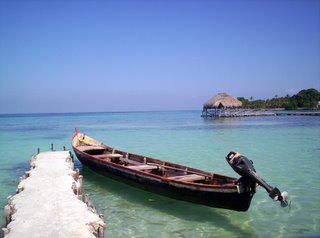
So, I went to spend some time this weekend in Cartagena with the folks visting from UC and we ended up taking a day trip to the Islas del Rosario. Like many things in Cartagena, the isla trip was nice and I enjoyed it, but I think I always expect more after hearing people talk about it. The lancha takes about one hour to get out to the archipelago, which is just outside the Bay of Cartagena. There's somewhere between 23 and 27 small islands, depending on who you're talking to, many of which are privately owned. We were on Isla Grande, at a place called Media Naranja. This was the first turquiose blue, what-I've-always-thought-the-Caribbean-should-look-like water I've seen since I've been here.

The interior of the island was also interesting, although not very accesible. One of the other girls and I started walking on our own, but a guide quickly caught up with us. That was probably for the better, since all of the paths looked the same! I didn't have my camera with me though, which was unfortunate. Lunch was included, too-the typical fried fish, arroz con coco, salad, and patacones.

The best part though, was the trip back. The sea was fairly calm in the morning when we went out, but the afternoon was a different story. It was the next best thing to a rollercoaster! Luckily, we had sat in the front of the lancha, so most of the water flew over us and hit the poor, unspecting people sitting in the back. I felt bad for the couples that had brought their babies with them...it must have been completely miserable. So, in the end, I'm nice and tan now, but I'm sure I'll lose it quickly over Christmas!

Monday, October 24, 2005

Cartagena de las Indias, Part II

Castillo de San Felipe de Barajas

So, one of the more interesting things I saw in Cartagena was the Castillo de San Felipe de Barajas. Cartagena was originally founded in 1533 by the Spanish and was at that time the principal port for the area. After various attacks by pirates and others looking for a piece of the Spanish wealth that sailed out from the city, construction was started of the Castillo in 1639. It became the most extensive fortification in South America. Check out the
Global Heritage Fund's website for more information on the Castillo (click on Colombia, then More).

The Castillo brought back memories of Fort Sumnter in Charleston (even though it was built much more recently) and of the fort in St. Augustine, Florida, which I think I remember going to at some point. We didn’t go through the structure with a guide, one because I hate guides and two because the groups were too big and I have a hard time understanding Spanish when there’s twenty people all talking at the same time. So I suppose I didn’t learn much of the history, but oh well. Next time, or in the guide book that I’m realizing that I really need to buy. The fascinating part of the Castillo was that I didn’t see any rooms inside. There were lots and lots of tunnels with small person-deep compartments off of them, supposedly for the Spaniards to hide in if someone attacked (if I’m wrong here, somebody please tell me!). It would be extremely easy to get lost inside…the tunnels just keep going down and they all look the same. I kept expecting to get to a room or chamber of some sort, but there was nothing. The fort itself is gigantic; I can’t imagine the manpower needed to build something of that size and complexity inside. But I won’t get into that now… More pics to come, but blogger's acting up right now and I have no patience to sit here and wait for it to upload!


Wednesday, October 19, 2005

Cartagena de las Indias, Part I

So on for this past weekend's puente, I went to Cartagena. As you can see from the pictures, it's a nice place, but I think I had rather high expectations based on the praises that people give it and what I've seen of colonial Mexico. Other than the high costs, the poverty that surrounds the beautiful parts of the city, and the overly persistent street vendors, I think that it would certainly be a more friendly and interesting place to live as compared to Barranquilla. There was not so much honking of the horns or out-of-control driving and it was possible to walk places without the fear of being run over even at night! The beaches right around the city were about the same as the main ones in Santa Marta, not great, but not the nastiness of Puerto Colombia. The Islas de Rosario are supposedly much more beautiful, but I didn't end up making it there. I especially enjoyed the snow cone vendors, like the one above, and even though I couldn't have one in fear of being sick another two weeks, I decided I want to buy one of the machines. All in all, though, I discovered that I need to buy a Colombia travel guide if only to have the name of decent cheap hotels. Finding a place to stay was horrible! More to come...

The Cathedral

Torre del reloj, where we entered the walled part of the city

Statue of Pedro de Heredia, founder of Cartagena

Peagusus Bridge (did I spell that right?) in Cartagena de las Indias